Share your photos, tips and experiences from Trnava and its surroundings.
Join the group ↗
5 Reasons to Visit Trnava: Slovakia’s Little Rome Without the Crowds

Just about 50 kilometres from Bratislava lies a city with an extraordinary historical heritage, a lively cultural scene and a distinctive atmosphere. Trnava, nicknamed Slovakia’s Little Rome, offers plenty of reasons to visit. Unlike Europe’s best-known destinations, you can enjoy it without battling tourist crowds or paying big-city prices.
Slovakia has many historic towns, but Trnava holds a special place among them. It was once one of the most important religious and educational centres of the Kingdom of Hungary. Its rich heritage is still visible throughout the city today.
Even so, Trnava remains relatively little known among international travellers. Yet it has much to offer, not only to lovers of architecture and history but also to visitors seeking an authentic atmosphere, culture and a more relaxed way to explore a European city. Here are five reasons to discover Slovakia’s Little Rome.
1. An exceptional concentration of historic sights in a small area
Trnava did not earn the nickname Little Rome by chance. Its historic centre contains one of Slovakia’s most remarkable collections of religious architecture. As many as eleven major churches and several chapels stand within a relatively small area. According to the city authorities, there are thirteen churches in Trnava as a whole.
The scale of this concentration becomes even more impressive when you consider the size of the old town. The medieval fortifications enclosed an area of approximately 56 hectares, or just 0.56 square kilometres. In the 13th century, Trnava was among the largest towns in Central Europe by area.
56 ha
Area of the medieval town
11
Major churches in the historic centre
3 km
Approximate length of the original city walls
Gothic, Renaissance, Baroque and later architecture still coexist in this compact area. The most important religious buildings include the Gothic Basilica of St Nicholas, which served for almost three centuries as the cathedral church of the archbishops of Esztergom, and the monumental Cathedral of St John the Baptist, home to a wooden altar more than twenty metres tall.
And the churches are only the beginning. The historic centre also contains two synagogues, the Archbishop’s Palace, the Renaissance City Tower, the historic town hall, a 19th-century theatre and numerous burghers’ houses. Another exceptional landmark is the extensive medieval brick fortification system, whose original perimeter measured approximately three kilometres. A substantial part of the walls survives today.
Lesser-known landmarks are worth exploring, too. One example is the 18th-century Emmer Villa, Trnava’s oldest surviving summer residence, which underwent extensive restoration in 2026.
The city’s layout is another major advantage. While visitors to large capitals often travel between sights by public transport, Trnava’s most important historic attractions can easily be explored on foot in a single afternoon.
Curious about the origin of the city’s unusual nickname? Read our article Why is Trnava called Little Rome?. For a complete overview of places worth visiting, see our guide to things to see in Trnava.
Explore Trnava’s historic centre on the map
Our interactive map shows Trnava’s best-known landmarks, historic streets, squares and other places of interest. Choose a short city walk or a longer route that also takes you through some of Little Rome’s lesser-known corners.
TIP: Click the icon in the top-left corner of the map and select either the short or the long walking route through Trnava. You can also display individual categories of landmarks and attractions.
2. A lively atmosphere, culture and welcoming urban spaces
Historic buildings are just one side of Trnava. The other is the atmosphere of a city that does not live solely on its past.
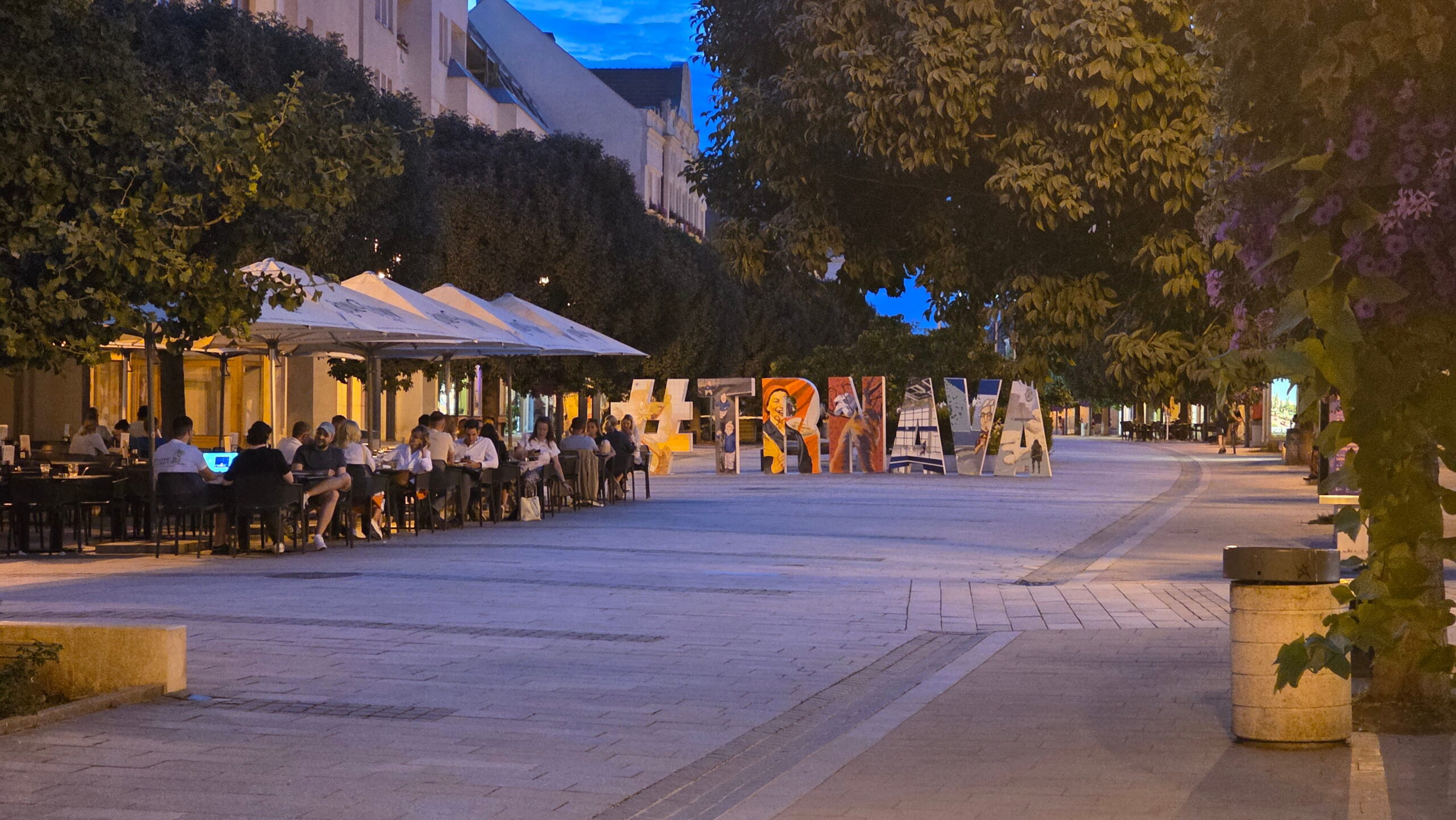
Its natural heart is Hlavná Street, a pedestrian zone lined with trees, flowerbeds, fountains, cafés and restaurant terraces. In the warmer months, public spaces become popular meeting places and hubs of social life.
Trnava also has a surprisingly rich cultural scene. The historic Ján Palárik Theatre is one of Slovakia’s leading regional theatres. In 2026 it was joined by the new Pracháreň Municipal Theatre, opened in a restored historic building right in the city centre.
Art lovers can visit the Ján Koniarek Gallery in Koppel Villa or its exhibition space in the former Status Quo Ante Synagogue, now used as a Centre for Contemporary Art.
Nádvorie has become a distinctive part of the city’s cultural life. This complex combines restored historic buildings with contemporary architecture, restaurants and cultural events. It also houses the Malý Berlín cultural centre, which regularly hosts concerts, discussions and other events.
Trnava has also changed considerably in recent years thanks to the renewal of its public spaces. Ružový Park with the restored Emmer Villa, the historic Promenade in Anton Bernolák Park and Béla IV Park offer pleasant places to relax just minutes from the major sights.
Football is inseparable from Trnava’s identity. Spartak Trnava is one of Slovakia’s best-known clubs, and its home ground, Anton Malatinský Stadium, stands right beside the historic centre. On match days, the city comes alive with an atmosphere that is exceptional in Slovakia.
Trnava thus combines a peaceful historic setting with an active urban life. Spend the afternoon admiring architecture, enjoy a theatre performance or concert in the evening, and end the day on one of the terraces in the centre.
Food and drink are part of the city’s appeal, too. Discover local restaurants, cafés and pastry shops or bars where you can round off your day.
3. A clean, peaceful and safe city
Safety is becoming an increasingly important factor when choosing a travel destination. Trnava has plenty to offer in this respect as well.
The historic centre is compact and easy to explore on foot. Much of it consists of pedestrian streets, squares and renewed public spaces. Visitors can therefore focus on discovering the city instead of navigating the complicated transport system of a major metropolis.
The wider safety situation in Slovakia is another advantage. In the international Global Peace Index 2026, the country ranked 29th out of 163 states assessed, ahead of Italy in 35th place and France in 99th.
The index does not directly compare crime rates in individual cities. It measures a broader concept of peace and security, including internal conflicts, societal safety and militarisation. Nevertheless, it offers a useful picture of conditions in different countries.
Slovakia is also rated favourably by the US Department of State, which assigns it the lowest travel advisory level, Level 1, meaning that travellers should exercise normal precautions. The country is generally considered a safe destination for visitors.
Of course, Trnava is not completely free of crime, and basic precautions are advisable everywhere. For travellers who prefer a calmer environment to the bustle of major cities, however, it makes an attractive alternative. Well-kept parks, renewed squares and numerous places to relax outdoors are an added bonus.
4. A historic gem without mass tourism
Rome, Venice, Prague and Barcelona are among Europe’s most visited destinations. Their popularity also has a downside: crowded streets, long queues at landmarks and historic districts where tourism has a major impact on everyday life.
Trnava offers almost the exact opposite.
The difference is clear in the statistics. According to the Trnava Tourism annual report, 57,581 visitors stayed in registered accommodation in the Trnava tourism region in 2024. The region includes the city itself and several surrounding municipalities.
In the same year, Bratislava recorded nearly 1.19 million overnight guests, Budapest around 6.73 million, Prague 8.08 million and Vienna approximately 8.17 million. Italy’s Rome registered more than 22 million tourist arrivals.
Although the geographical areas and statistical methods are not completely identical, the gap in the scale of tourism is enormous. The figures mainly cover visitors staying in accommodation, not everyone who comes on a day trip.
For visitors, this means freedom above all. When walking through Trnava’s historic centre, you do not have to constantly weave between tour groups. You can admire many landmarks in peace, photograph them without crowds and discover the streets at your own pace.
That does not mean the city is empty. During festivals, Christmas markets, major religious celebrations or football matches, the centre can become very lively. For most of the year, however, it retains the natural rhythm of a city whose historic heart primarily serves its residents.
Trnava is neither a miniature version of Rome nor a substitute for Europe’s great capitals. It is a historic destination in its own right, and one of its greatest strengths is the chance to experience valuable cultural heritage without the drawbacks of mass tourism.
5. Good value for international travellers
Travelling around Europe’s major cities can be expensive. Accommodation in the historic centre, restaurant meals and attraction tickets can quickly increase the cost of even a short weekend break.
Compared with much of Western Europe, Slovakia is a more affordable destination. International statistics support this comparison.
According to Eurostat data for 2025, the price-level index for restaurants and hotels in Slovakia was 84.6, compared with an EU average of 100. The corresponding index was 110.8 in Italy, 116.8 in Austria, 116 in France and 108.4 in Germany.
For visitors arriving from these countries, a trip to Slovakia can therefore be noticeably cheaper, especially for food and accommodation. These figures compare prices at national level, not in specific cities, but illustrate the differences between European destinations.
Trnava also offers accommodation across different categories, from modest apartments and smaller guesthouses to comfortable hotels in the historic centre. The dining scene is equally varied, with traditional Slovak dishes, international cuisine and modern restaurant concepts.
Short distances are another advantage. Visiting the main sights does not require taxis or regular use of public transport. You can do much of your sightseeing on foot, while many of the best experiences — including walks through historic streets and parks — are entirely free.
If you plan to spend more than one day in Trnava, explore our recommendations for where to stay in Trnava and our guide to restaurants, cafés and bars.
Discover Slovakia’s Little Rome
Trnava may not have the Colosseum, the Vatican or millions of tourists. What it does have is its own character: an exceptionally well-preserved historic centre, numerous churches and other landmarks, a rich cultural life and an atmosphere that can be enjoyed without rushing.
Whether you are looking for a day trip, a romantic weekend or a stop on a journey through Slovakia and Central Europe, Little Rome deserves a place on your itinerary.
And if you have more time, Trnava makes an excellent base for exploring the surrounding area. Nearby highlights include Smolenice and its castle, the spa town of Piešťany and the castles and hiking trails of the Little Carpathians. Find inspiration in our day trips from Trnava.